
Quality Control for Custom Plush Manufacturing
Protect your approved design from material intake to final shipment. Ewin Toys combines 100+ quality personnel, staged inspections and production references to reduce sample-to-bulk variation in appearance, dimensions, filling, embroidery, accessories and packaging.
IQC / IPQC / FQC / OQC | Golden Sample & BOM Control | Critical Dimension Checks | Attachment & Seam Inspection | ASTM F963 / CPSIA / EN 71 Testing Support | Batch Traceability
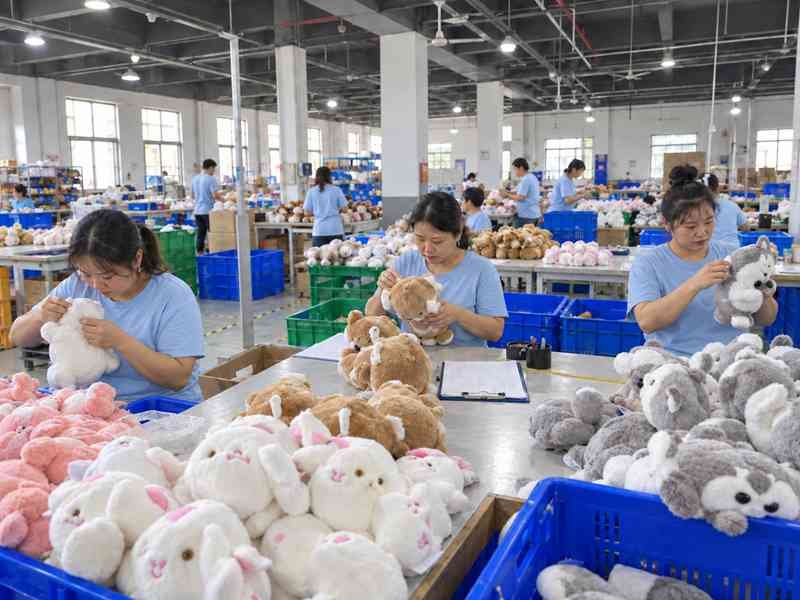
Quality Control Starts Before Final Inspection
Reliable plush quality depends on a defined standard, early prevention, stage-by-stage checks, controlled reactions, and records that remain tied to the correct SKU.
Approved Standard
Incoming Control
Process Control
Finished Control
Outgoing Control
Corrective Action
Quality Risks Change With the Plush Product
Each product family needs different CTQs because appearance, structure, hardware, function, packaging, and failure modes change with construction.
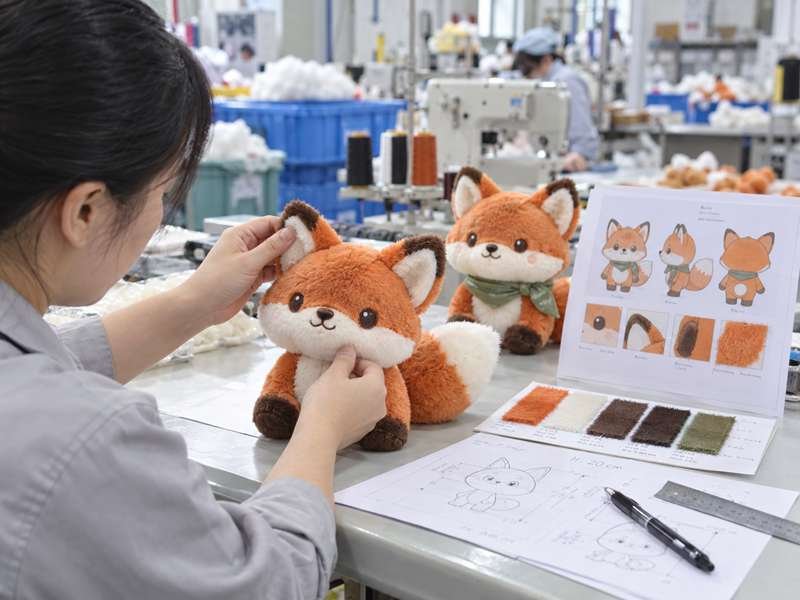
Character & Mascot Plush
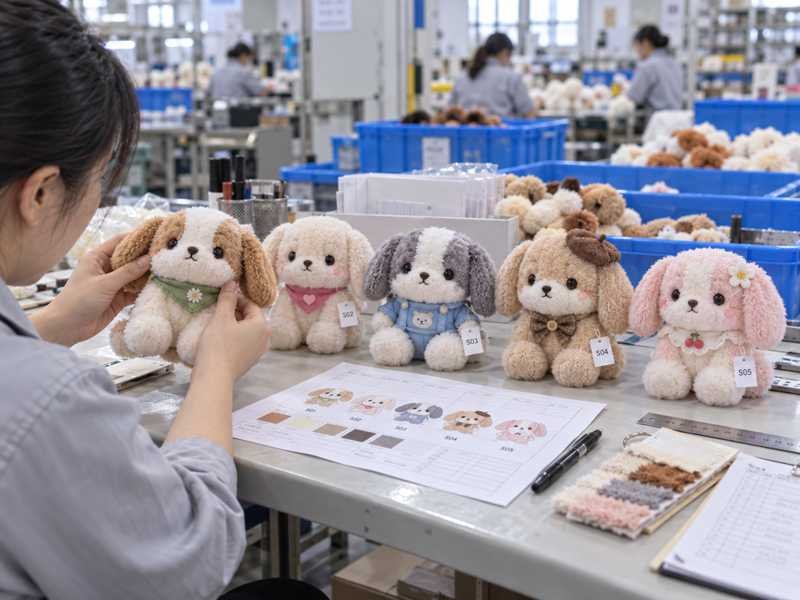
Collectible Plush
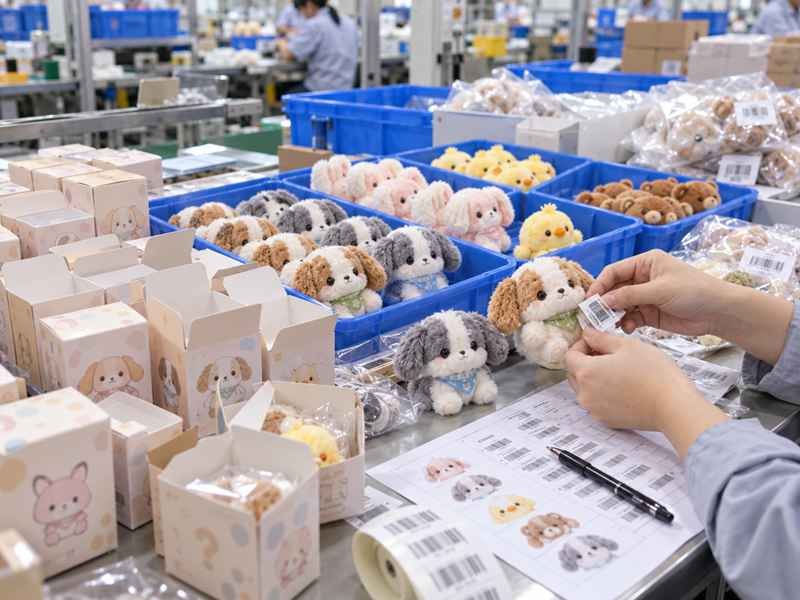
Mini & Blind Box
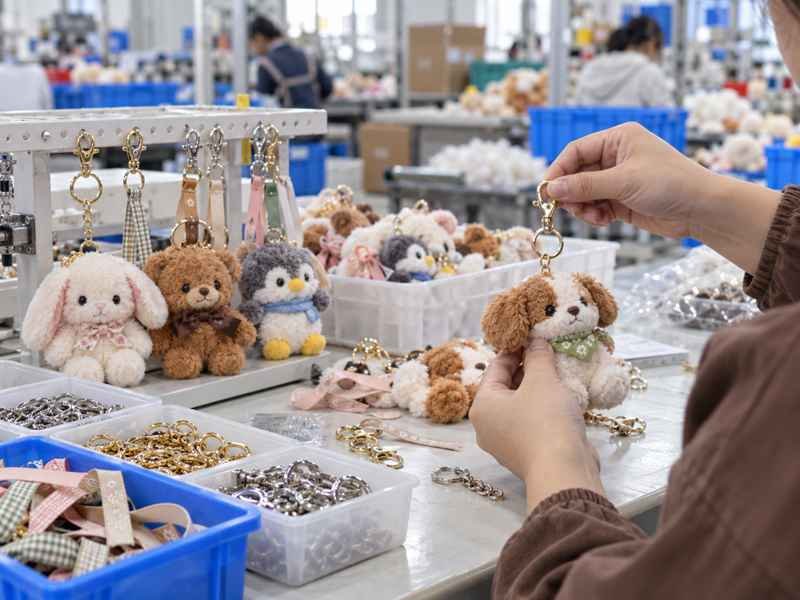
Keychains & Bag Charms
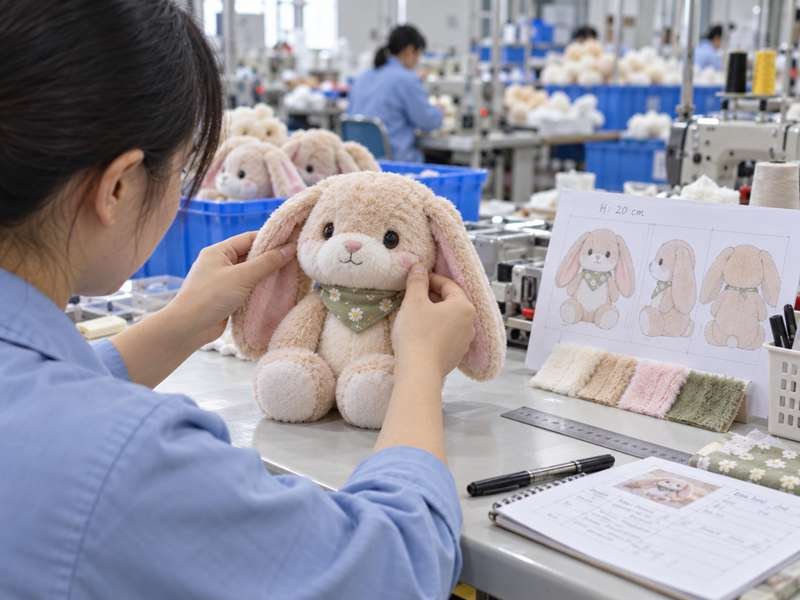
Standard Custom Plush
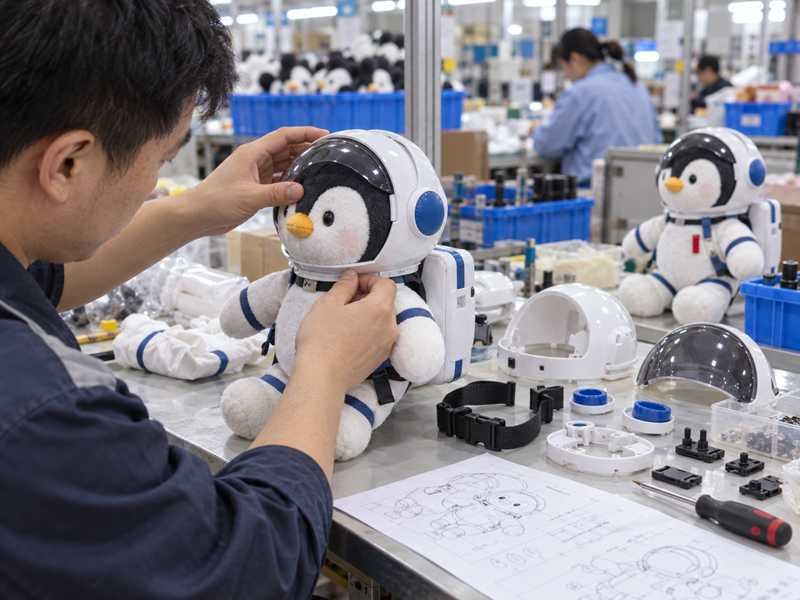
Hybrid Plush Products
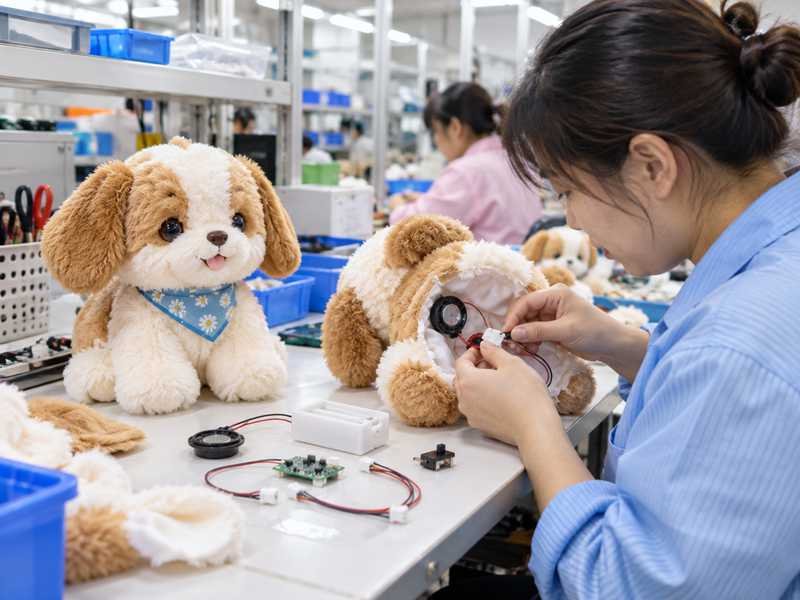
Electronic & AI Plush
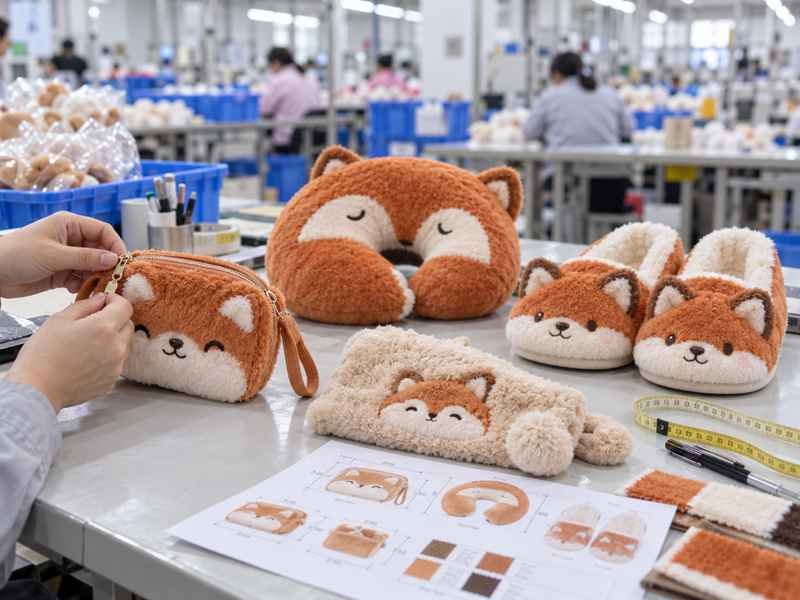
Lifestyle Plush Merchandise
Quality Priorities Change With the Commercial Program
Brand ownership, approval structure, sales channel, SKU count, and return risk determine which quality evidence matters most to each program.
Global Brand Teams
Global brands usually need repeatability, traceability, documented reactions, packaging consistency, and stable reorders across several launches. Quality records should show which standard was used, which lot was inspected, what happened when a problem appeared, and what changed before the next run.
IP Owners
IP owners need fidelity and version control to be treated as quality requirements. Facial features, silhouette, color, clothing, accessories, and artwork approvals should stay linked to the correct production revision while confidential samples and files remain controlled.
Licensing Companies
Licensing projects often involve several approval parties, markets, and packaging versions. Quality control should prevent old artwork, wrong legal copy, mixed market labels, and unauthorized product revisions from entering the finished goods.
Toy Companies
Toy companies commonly manage product families with varied structures, age grades, materials, and functions. QC should be product-specific, with the right physical checks, process gates, traceability, and test coordination for each SKU rather than one generic toy checklist.
Collectible Brands
Collectible quality depends heavily on appearance, handfeel, finishing, series consistency, clothing, accessories, and packaging condition. Small cosmetic differences that might pass a basic commodity inspection can still damage collector perception and retail value.
Retail & Private Label
Retail quality extends beyond the plush into barcode, warning, case pack, carton marks, assortment, and receiving requirements. OQC should confirm that the finished shipment is commercially usable for the intended retailer or distribution center.
E-Commerce Programs
E-commerce programs face visible cosmetic defects, crushed appearance, missing accessories, barcode problems, and return risk at unit level. QC and packaging need to protect unboxing condition as well as manufacturing workmanship.
Technology & AI Teams
Technology programs need plush QC to stay synchronized with module revision and function. A module update can change cavity, wiring, access, fixing, packaging, or test requirements, so function evidence must remain tied to the correct hardware and product version.
Quality Needs One Approved Product Definition
Inspectors can only make consistent decisions when physical references, materials, patterns, artwork, measurements, and packaging describe the same released SKU.
Golden Sample Sets the Physical Quality Reference
The Golden Sample represents the approved physical result: character proportions, face, silhouette, handfeel, filling, clothing, decoration, component placement, and overall presentation. It should be identifiable by project, SKU, revision, and approval status so production and QC do not confuse it with a prototype, sales sample, testing sample, or obsolete revision.
Physical comparison: Inspectors can compare appearance, shape, handfeel, and assembly against one agreed reference instead of relying on memory or photos.
Reference control: Factory and QC reference samples can be maintained where separate controlled samples help daily manufacturing and inspection.
Limitation: A physical sample cannot reveal every hidden material code, embroidery file, filling weight, component specification, or packaging instruction. Golden Sample therefore works with the Frozen BOM and released files rather than replacing them.
Frozen BOM Sets the Material and Component Standard
The Frozen BOM carries details that are not reliably visible from the finished sample: main and secondary fabrics, lining, thread, embroidery thread, filling, accessories, hardware, modules, labels, hangtags, packaging, and other controlled items.
Material identity: Supplier route, specification, color, GSM, pile, size, or part information can be tied to the approved product where relevant.
Substitution control: A visually similar fabric, eye, magnet, thread, label, or package should not enter bulk production without review of appearance, assembly, testing, cost, and timing impact.
QC value: IQC can inspect incoming lots against defined inputs, while later investigations can trace a finished problem back to the material or component lot actually used.
Released Pattern and Artwork Set the Process Standard
Pattern and decoration files define geometry and visual details that the Golden Sample cannot communicate precisely. Released Pattern should identify panel shape, seam allowance, openings, mirrored parts, nap direction, and other information needed for controlled cutting and sewing.
Artwork control: Embroidery, print, applique, logo, and legal files should use approved revisions, final size, placement, colors, and applicable process notes.
QC value: IPQC can verify cutting, decoration, and assembly against current files instead of judging only after the product is completed.
Version control: Obsolete patterns or artwork should be blocked from production after an approved change, preventing old details from reappearing in bulk or reorders.
Packaging Specification Sets the Commercial Quality Standard
A plush product is not commercially correct when the toy is right but the packaging identity is wrong. Packaging specifications should define unit pack, label, warning, barcode, insert, retail box, blind box, case pack, carton marks, and destination requirements relevant to the program.
SKU mapping: Each packaging version should remain connected to the correct product, market, barcode, and shipment route.
Outgoing quality: OQC can verify packaging condition, scanability, quantity, carton configuration, and shipment identity before goods are released.
Brand protection: Controlling packaging versions prevents old legal copy, wrong warnings, mixed barcodes, and cross-SKU packs from becoming market-facing quality failures.
Certificates, Compliance & Quality Assurance
Ewintoys follows structured quality and compliance practices for custom plush production. We hold relevant certifications and support additional testing, inspection, and compliance documentation based on specific product requirements and destination markets, helping brands meet different international standards with confidence.
























Sample Quality Control Builds the Bulk Standard
Prototype, revision, PP, and Golden stages should close different quality questions before the approved product becomes the reference for mass production.
Prototype QC Checks Whether the Product Direction Is Correct
A prototype is not inspected as if it were already stable mass production. Early QC focuses on whether the product has been interpreted correctly: proportion, silhouette, face, material behavior, construction, filling, component interface, and obvious workmanship that could distort the development review.
Development focus: Separate design questions from avoidable execution defects so brand comments are spent on the product rather than problems that the sample team could have caught internally.
Record focus: Note which areas are still experimental, which materials are provisional, and which dimensions or structures remain open.
Quality value: The prototype becomes a useful engineering decision point without giving the false impression that every hand-finished development condition is already production-ready.
Revision QC Keeps Approved Features From Moving Backward
V1, V2, V3, and later revisions should show what changed and what stayed approved. Sample QC can compare the new version with previous comments, current artwork, measurements, materials, decoration, components, and the specific objective of the revision.
Change discipline: If eye position is approved in V1 while ear shape changes in V2, the next sample should not accidentally reopen the eye position unless another approved change requires it.
Version evidence: Sample ID, revision, date, comments, and approval status reduce the risk of a rejected version returning later.
Quality value: Revisions converge toward a stable product rather than creating a sequence of different samples that cannot be connected to one manufacturing definition.
PP Sample Checks Production-Representative Conditions
The PP Sample should represent final bulk conditions as closely as practical: production material, construction, accessories, labels, and packaging rather than development-only substitutes. Its purpose is to expose whether the product remains correct when moved from sample-room methods toward real manufacturing inputs.
What to review: Material lot, decoration result, sewing route, filling, component fit, labels, packaging, CTQs, and any production-specific risks identified during NPI.
Testing relevance: Where a sample supports physical or formal testing, it should remain traceable to the relevant SKU, revision, and BOM so later changes can be assessed for representativeness.
Quality value: PP review finds production-readiness gaps before those gaps are multiplied across the bulk order.
Golden Sample Release Converts Approval Into a Quality Baseline
Once the product is approved for bulk, the Golden Sample should be connected to Frozen BOM, Released Pattern, final artwork, measurement points, filling reference, component details, labels, packaging, and the Project QC Plan.
Physical baseline: Golden Sample defines what the product should look and feel like.
Data baseline: BOM and released files define what it is made from and how key details are executed.
Inspection baseline: CTQs identify which features receive focused checks and what reaction is required when they move outside the accepted condition.
Quality value: The approved sample stops being a marketing or development object and becomes part of a controlled production-quality system.
Project QC Plans Turn Approvals Into Checkpoints
A project-level QC Plan defines what matters, where it is checked, how it is judged, and what happens when the result fails.
| CTQ / Quality Item | Primary Gate | Method / Reference | Typical Reaction When Failed |
|---|---|---|---|
| Character Face / Eye Position | IPQC / FQC | Golden Sample, measurement points, visual template | Hold affected work, correct source process, recheck before release. |
| Fabric Color / Pile / Lot | IQC | Approved swatch, material specification, lot record | Hold lot, confirm scope, approve replacement or reject before use. |
| Embroidery / Print Placement | IPQC | Released artwork, coordinates, first-piece reference | Stop process, correct program or positioning, verify first piece again. |
| Seam / Construction | IPQC | Released Pattern, workmanship criteria, seam requirement | Segregate affected WIP, correct process, re-inspect repaired work. |
| Filling / Weight / Shape | IPQC / FQC | Filling specification, weight record, Golden Sample | Adjust process or affected units, verify handfeel and appearance. |
| Hardware / Accessory Fixing | Assembly / FQC | Part specification, installation note, applicable pull/torque check | Hold affected units, correct fixing, verify attachment and scope. |
| Electronic Function | Assembly / FQC | Module revision, function checklist, assembly reference | Segregate, diagnose module/assembly cause, re-test after correction. |
| Label / Warning / Barcode | Packaging / OQC | SKU master, approved artwork, scanner | Stop packing/release, correct labels or data, re-scan affected units. |
| Carton / Case Pack | OQC | Packaging spec, count, carton marks, PO requirement | Hold shipment, correct pack count or marks, verify before release. |
| Needle / Metal Risk | Multiple Gates | Needle-control procedure, detector calibration, test pieces | Isolate affected time window/batch, investigate, re-screen as required. |
Incoming Quality Stops Wrong Inputs Before Production
IQC protects the released product by checking materials, components, filling, electronics, and packaging before they become part of bulk production.

Fabrics
- Prevents: wrong color, wrong pile, surface defects, unapproved substitution.
- Traceability: material lot can remain linked to the products that used it.

Threads & Decoration Inputs
- Prevents: color drift, wrong thread, incompatible process input.
- Traceability: thread/ink lot can support later color or process investigation.

Accessories & Hardware
- Prevents: wrong parts, surface defects, dimension mismatch.
- Traceability: supplier lot and component identity support targeted containment.

Filling & Inserts
- Prevents: wrong filling, contamination, inconsistent weight or feel.
- Traceability: filling lot can be linked to affected production where needed.
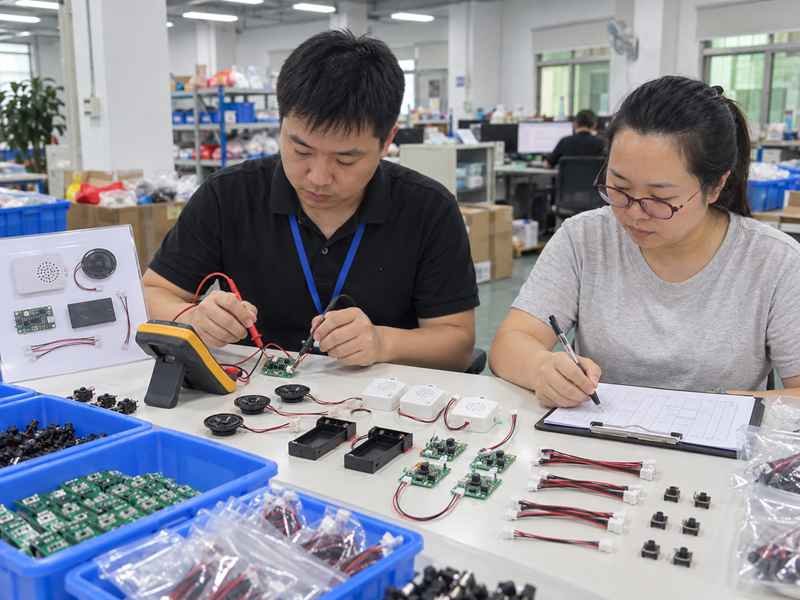
Electronic Modules
- Prevents: wrong revision, visible damage, dead modules.
- Traceability: module or supplier lot supports function-failure investigation.
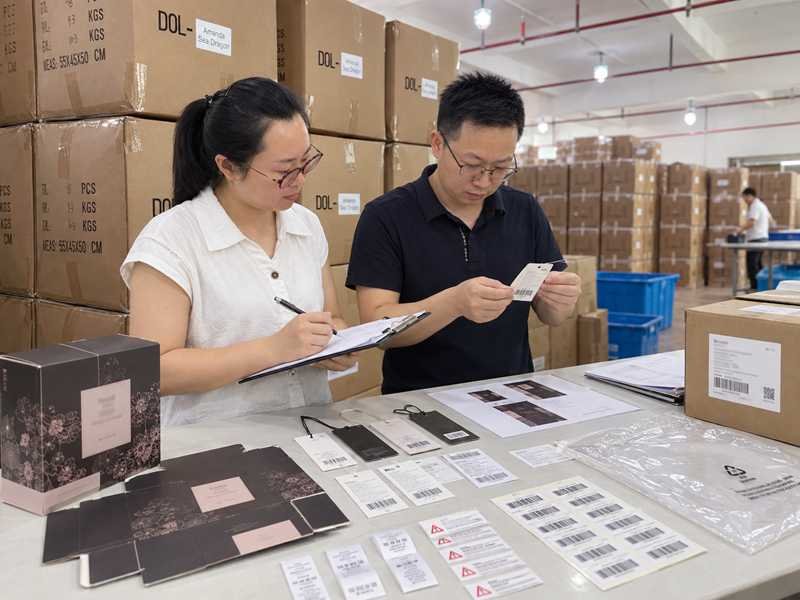
Labels & Packaging
- Prevents: old artwork, wrong market label, incorrect barcode or pack.
- Traceability: print or packaging batch supports outgoing investigations.
Quality Gates Follow the Product Through Bulk Production
Checks sit near the process that creates the risk so defects can be contained before additional labor, materials, and packaging are added.

Cutting
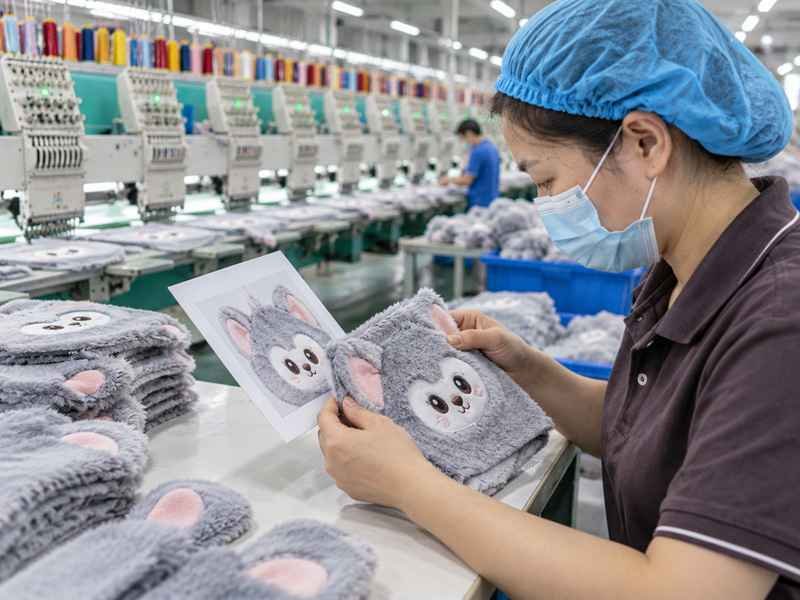
Embroidery & Printing

Sewing

Stuffing
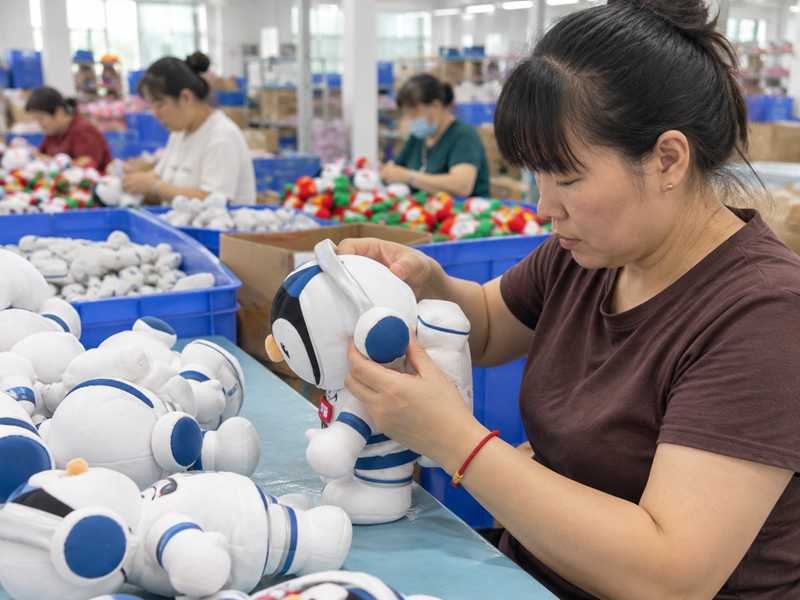
Assembly
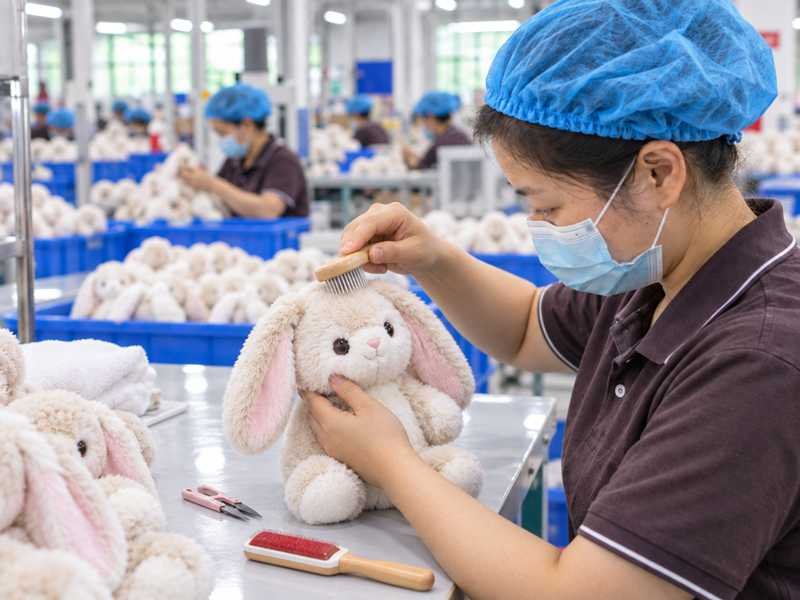
Shaping & Finishing
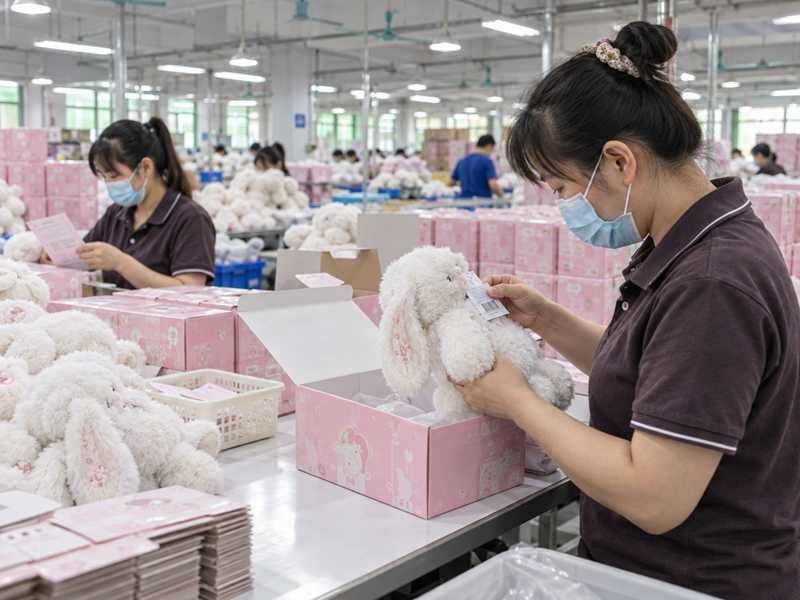
Packaging

Shipment Release
Four QC Gates Control Different Failure Points
IQC, IPQC, FQC, and OQC each prevent a different type of quality escape and use the references relevant to that stage.
IQC - Incoming Quality Control
- If failed: hold the incoming lot, confirm scope, and block production use.
- Prevents: wrong inputs becoming thousands of finished defects.
IPQC - In-Process Quality Control
- If failed: stop or segregate affected WIP, correct the process, verify again.
- Prevents: repeat defects moving into later manufacturing stages.
FQC - Finished Quality Control
- If failed: segregate, classify severity, rework or escalate as required.
- Prevents: nonconforming finished units entering final commercial packing.
OQC - Outgoing Quality Control
- If failed: hold shipment until correction and re-verification are complete.
- Prevents: correct plush being shipped under the wrong commercial identity.
Physical Checks Target Product-Specific Failure Risks
Internal physical and process checks support development and production control; formal regulatory or chemical conclusions remain tied to the relevant market and testing scope.
Pull & Torque
Pull and torque checks can support eyes, noses, hardware, accessories, and other attached parts where fixing strength matters. Results should remain connected to the component, construction, SKU, and relevant project requirement.
- Useful for: attachment and detachment risk.
- Important link: a failed attachment can also create a small-parts risk.
Seam & Tensile
Seam strength focuses on the sewn joint, while tensile checks can evaluate material or structural load behavior. The result can help identify whether the weak point is fabric, thread, stitch, seam allowance, or construction.
- Useful for: seams, loops, straps, structural joins.
- Quality value: converts a failure into an engineering correction point.
Small Parts
Small-parts evaluation is relevant when a component can detach or a broken product can create a swallowable piece. Product age grade, component size, fixing, and failure mode need to be considered together.
- Useful for: eyes, noses, accessories, broken hard parts.
- Quality value: links attachment failure with downstream safety risk.
Sharp Point & Edge
Sharp-point and sharp-edge checks are especially relevant to hard components, metal hardware, molded parts, and broken-product conditions. A component can appear acceptable before failure but become hazardous after damage.
- Useful for: plastic, metal, hybrid structures.
- Quality value: reviews both normal and foreseeable damaged conditions where applicable.
Color & Colorfastness
Light-box comparison, spectrophotometer, rubbing, or colorfastness tools can support color and lot control across fabric, print, clothing, and decoration. Different surfaces may reflect the same color intent differently.
- Useful for: color difference, rubbing transfer, lot drift.
- Quality value: keeps appearance decisions tied to real materials, not screen color alone.
Drop & Compression
Drop, impact, or compression checks can support hybrid products, electronics, rigid components, premium packaging, and compressed plush where structure or arrival condition is at risk.
- Useful for: hard parts, modules, packaging durability.
- Quality value: validates the relevant failure mode rather than applying one test to every plush.
Needle Control Is a Managed Production Process
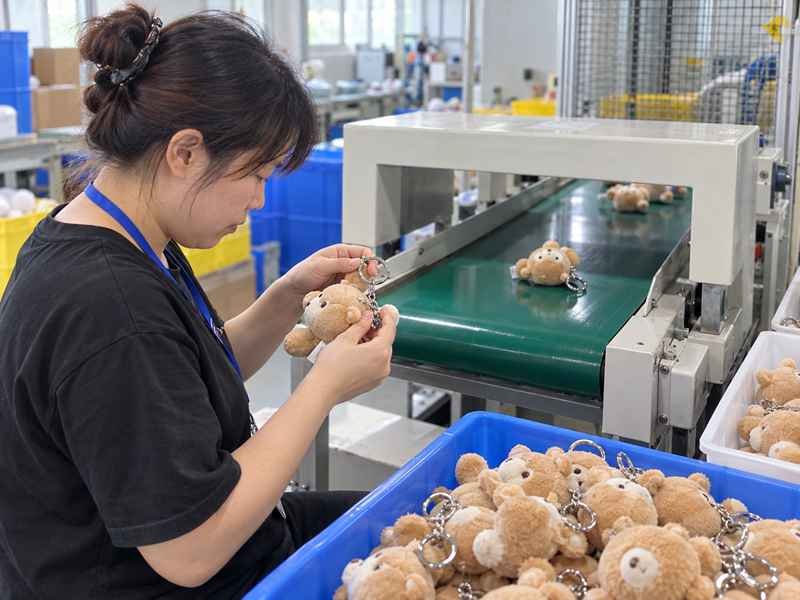
Needle and foreign-material risk is controlled through tool management, calibrated detection gates, isolation, and product-specific handling – not one final machine pass.
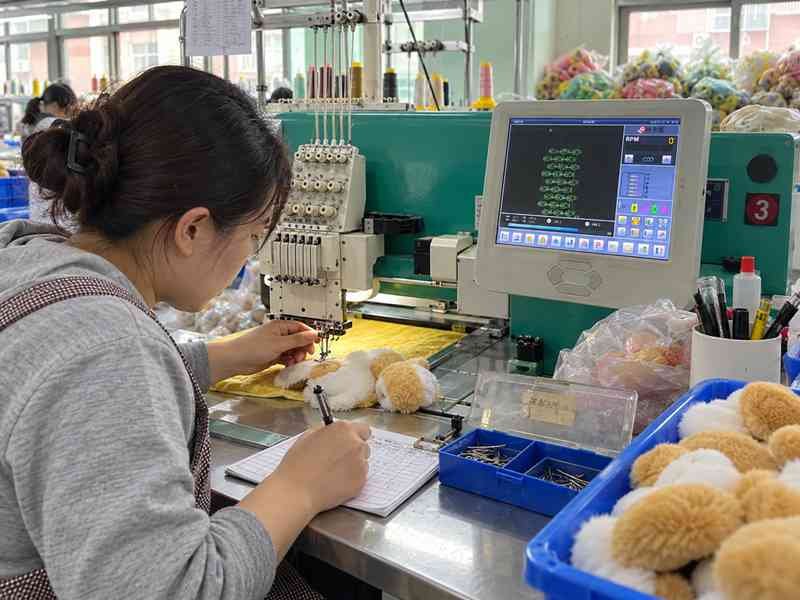
Needle Issue Control
- Control: issue and breakage record.
- Value: creates a defined investigation scope instead of screening the entire order blindly.
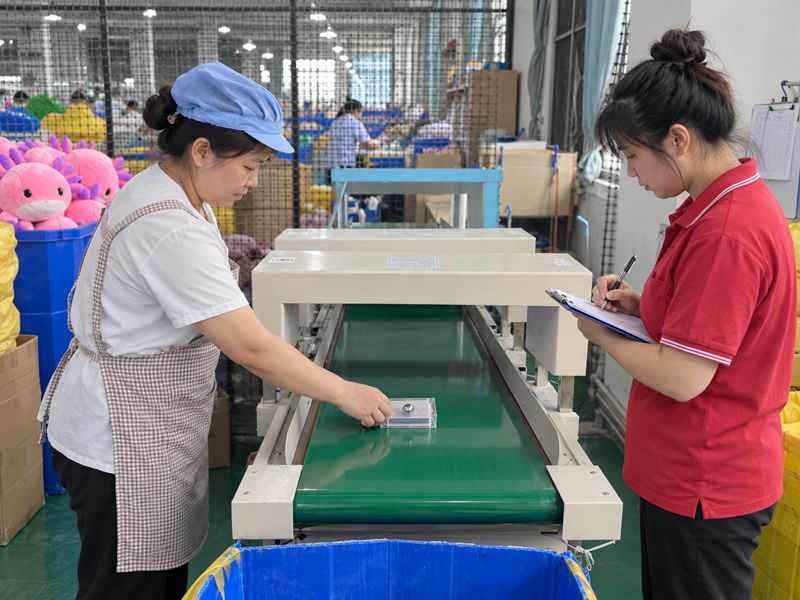
Detector Calibration
- Control: calibration or sensitivity verification.
- Value: turns equipment presence into a repeatable quality gate.
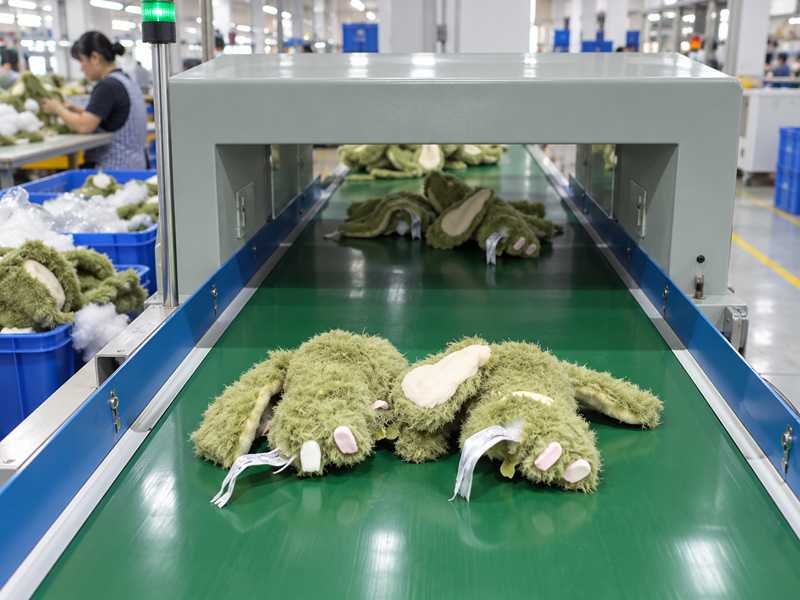
In-Process Gate
- Control: batch/gate record.
- Value: narrows affected scope earlier when an abnormality is detected.
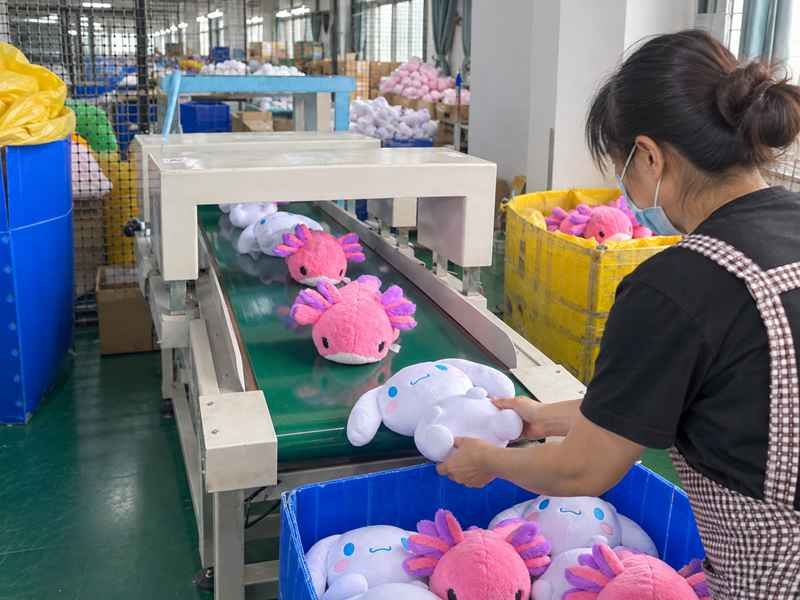
Finished-Goods Gate
- Control: finished-batch screening record.
- Value: verifies the product after major needle-related processes are complete.
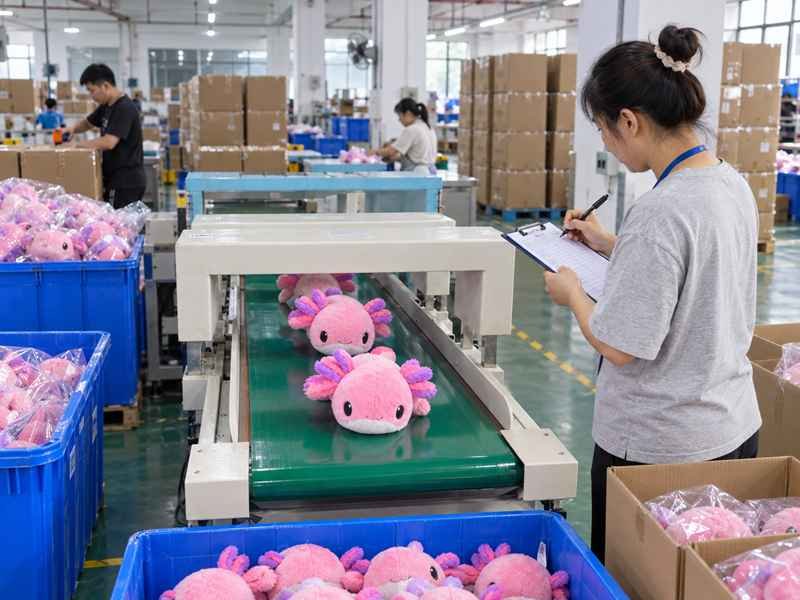
Pre-Shipment Gate
- Control: final detection and release linkage.
- Value: adds another barrier before goods leave controlled factory processes.
Metal-Designed Products
- Control: product-specific foreign-material plan.
- Value: distinguishes intended metal from unintended contamination without weakening control.
A Defect Library Moves Quality From Detection to Prevention
Known failure patterns help engineers and inspectors place controls where problems start instead of rediscovering the same defect after every order.
Character Appearance
- Typical gates: sample QC, IPQC, FQC.
- Prevention: key-point definition, Golden comparison, controlled shaping.
Fabric & Material
- Typical gates: IQC, cutting, FQC.
- Prevention: material ID, lot control, approved substitute process.
Decoration
- Typical gates: first piece, IPQC, FQC.
- Prevention: released artwork, coordinates, approved thread/program.
Sewing & Structure
- Typical gates: sewing IPQC, FQC.
- Prevention: Released Pattern, work instruction, seam checkpoints, bundle control.
Filling & Shape
- Typical gates: stuffing IPQC, FQC.
- Prevention: filling spec, weight reference, shaping standard.
Accessories & Hardware
- Typical gates: IQC, assembly IPQC, FQC.
- Prevention: Part ID, fixing method, physical check, assembly reference.
Functional Failure
- Typical gates: incoming module check, assembly, FQC.
- Prevention: module revision, interface control, function check.
Packaging & SKU
- Typical gates: packaging QC, OQC, warehouse release.
- Prevention: pack matrix, scan verification, line clearance, carton and storage controls.
Defect Severity Determines the Reaction Plan
Critical, Major, and Minor findings should trigger different containment, disposition, escalation, and corrective-action decisions instead of one generic rework response.
| Severity | What It Means | Typical Reaction | Management Purpose |
|---|---|---|---|
| Critical | Potential safety, regulatory, severe functional, wrong identity/version, or another unacceptable major risk | Immediate Hold; segregate affected scope; stop movement; management/technical review; CAPA where required | Prevent release of high-risk product and define affected scope before work continues. |
| Major | Clear impact on appearance, dimensions, function, attachment, series consistency, or retail sellability | Segregate; rework, remake, or sort; determine whether issue is systemic; repeated issues enter CAPA | Restore sellable product and prevent a recurring process problem from being treated as isolated rework. |
| Minor | Workmanship or appearance deviation that does not affect safety or core function and remains within project-defined allowances | Dispose according to QC Plan; monitor frequency and trend | Stop accumulation of small defects from becoming a systematic quality or presentation problem. |
CAPA Closes the Cause, Not Only the Defect
Corrective and Preventive Action should explain why a problem happened, why existing controls missed it, and what proves the revised system works.
Define the Problem With Product and Revision Facts
A useful CAPA begins with a factual defect statement, not “quality bad.” The record should identify what failed, where it failed, when it was found, which SKU and revision were involved, the affected quantity or scope, and the evidence available.
Product identity: Link Project ID, SKU, revision, batch, material or component lot, production stage, QC gate, and packaging status where relevant.
Severity: Determine whether the issue is Critical, Major, or another repeat/systemic problem that requires formal escalation.
Quality value: A precise statement makes containment and root-cause work targeted. Without a defined scope, teams may either isolate too little product and allow escape, or hold an entire order unnecessarily because the affected population cannot be distinguished.
Find Both Root Cause and Escape Cause
Root-cause analysis needs two answers: why the defect happened and why the existing control system did not stop it before the next stage or shipment. “Operator error” alone is rarely enough because it does not explain why the process allowed the error or why the quality gate missed it.
Occurrence cause: Review pattern, material, machine setting, fixture, method, training, component, program, environment, or design condition that created the failure.
Escape cause: Review the missing or ineffective CTQ, inspection timing, sampling method, reference, record, reaction, or version control that allowed the defect to pass.
Quality value: Fixing both causes reduces the chance that another operator, line, or later order repeats the same failure under the same system weakness.
Contain the Current Risk Before Correcting the System
Containment prevents the known issue from spreading while investigation continues. Affected work-in-progress, inventory, packed goods, materials, components, or already released batches may need to be isolated according to the identified scope.
Scope confirmation: Use lot, line, date, SKU, material, component, packaging, and inspection data to determine what could be affected.
Immediate action: Stop the relevant process, sort or screen affected units, protect unaffected goods, and define any rework or retest route needed before release.
Quality value: Containment protects the current order without confusing temporary sorting with permanent prevention. It buys time to investigate correctly while keeping known-risk product under control.
Correct, Prevent, Verify, and Update the Standard
Corrective Action changes the direct cause through process, material, fixture, program, training, equipment, or design improvement. Preventive Action expands the learning to similar SKUs, processes, suppliers, or future projects where the same risk could recur.
Update control: Revise work instructions, CTQs, checklists, training, approved process settings, or product files when the solution changes the manufacturing standard.
Verification: Use re-inspection, retest, first-piece review, or later-batch evidence to confirm the action is effective before CAPA is closed.
Quality value: A closed CAPA should leave the system stronger than before the incident. The learning becomes available for future bulk orders and reorder delta reviews instead of disappearing after the affected units are reworked.
Traceability Narrows the Affected Scope Faster
Product, material, production, QC, packaging, and shipment records should support both backward investigation and forward identification of affected goods.
| Traceability Object | Example Fields | Investigation Value |
|---|---|---|
| Fabric | Material ID, supplier/spec, color lot, GSM/pile, received date, IQC status | Trace color, handfeel, nap, specification drift, or material defects. |
| Accessory | Part ID, supplier lot, size/color, received date, IQC/testing | Trace loose parts, wrong components, finish, magnets, hardware, or electronic issues. |
| Decoration | Thread/ink/film lot, artwork/program revision, machine/batch, date | Trace embroidery placement, logo, color, migration, or old-program errors. |
| Cutting | Pattern revision, material lot, marker/bundle ID, date/shift | Trace wrong nap, wrong panel, dimensions, or mixed SKU. |
| Sewing | Line/team, work order, SKU/bundle, date/shift | Trace seam, alignment, series inconsistency, or process variation. |
| Stuffing / Assembly | Filling/accessory lot, team, weight record, date | Trace filling, balance, attachment, hardware, or functional issues. |
| Needle / Finishing | Detection gate, calibration, batch, inspector, date | Trace metal/needle-control status and abnormal isolation. |
| FQC | SKU, revision, Golden/QC reference, lot, inspector | Connect finished-product judgment to the correct product and batch. |
| Packaging | Packaging batch, label/barcode revision, packing line/date | Trace wrong pack, wrong barcode, mixed SKU, carton, or market version. |
| OQC / Shipment | PO, carton, destination, release record, shipment batch | Trace what left the factory and identify unreleased or affected shipment scope. |
Multi-SKU Programs Need Quality Control by Identity
Large collections require the correct design, sample, BOM, artwork, packaging, barcode, test status, and production revision to remain aligned for every SKU.
SKU Master
- Prevents: mixed characters, sizes, colors, and destination versions.
- Quality value: one reference point for program-level identity control.
Sample Revision
- Prevents: rejected sample details returning to bulk.
- Quality value: keeps approval history connected to current manufacturing.
BOM Revision
- Prevents: unapproved material swaps and wrong component allocation.
- Quality value: supports both consistency and efficient traceability.
Artwork Revision
- Prevents: wrong face, logo, text, or market information.
- Quality value: protects visual and legal identity at production scale.
Pack & Barcode Matrix
- Prevents: wrong barcode, wrong market pack, mixed assortment.
- Quality value: strengthens Packaging QC and OQC release accuracy.
Production & QC Status
- Prevents: held or obsolete goods being released accidentally.
- Quality value: supports wave planning, containment, and shipment accuracy.
Outgoing Quality Includes Packaging and Shipment Identity
A qualified plush can still fail commercially through the wrong label, barcode, assortment, carton count, protection, or shipment release.
Unit Pack Condition
Polybag, compression, box, insert, and accessory protection should preserve the approved product condition. Pack-out checks can review deformation, wrinkles, trapped pile, scratches, loose parts, cleanliness, and recovery where relevant.
- Prevents: qualified products arriving visually damaged by their own packaging.
- OQC link: unit condition remains part of shipment readiness.
Labels & Warnings
Brand labels, care labels, composition, age or warning information, and other market-facing text should use the approved language, artwork, location, and SKU version.
- Prevents: old text, wrong market version, missing or misplaced labels.
- OQC link: label identity is checked before commercial release.
Barcode Verification
UPC, EAN, FNSKU, retailer, or internal SKU barcodes supplied for the program need the correct data, placement, readability, and product mapping. Scan verification can be used where required.
- Prevents: receiving, fulfillment, or retail scanning failures.
- OQC link: barcode is treated as product identity, not only packaging artwork.
Assortment Control
Blind boxes, mixed displays, multi-character cases, and retailer assortments need controlled counts and SKU separation. Line clearance and pack matrices reduce cross-SKU contamination during changeover.
- Prevents: incorrect mix, hidden-edition errors, wrong display composition.
- OQC link: assortment is verified against the approved commercial plan.
Carton Quantity & Marks
Units per carton, carton marks, PO, SKU, destination, weight, and count should match the approved packing specification. Cross-checks can help identify count or wrong-carton errors before shipment.
- Prevents: receiving discrepancies and mixed destination cartons.
- OQC link: carton identity supports traceability after factory release.
Shipment Release
OQC confirms that quality, packaging, carton, quantity, documentation, and destination requirements are sufficiently closed before goods leave controlled factory status.
- Prevents: shipment of held, wrong-version, or commercially incorrect goods.
- OQC link: release becomes a documented decision, not an automatic warehouse action.
Inspection Strategy Must Match the Quality Question
100% checks, sampling inspection, physical testing, and third-party inspection serve different purposes and should not be presented as interchangeable proof.
Use 100% Inspection for Items Suitable for Unit-by-Unit Checks
Ewin’s quality knowledge defines 100% Inspection as checking every unit for quality items that are suitable for individual inspection, such as visible workmanship, open seams, severe contamination, missing parts, wrong SKU or label, obvious deformation, key assembly errors, and project-designated Critical items.
Project level: High-fidelity IP, collectible, electronic, or retail programs can add unit-by-unit CTQs such as key facial points, Logo, important attachments, or function when the project requires it.
Boundary: Destructive, laboratory, material-performance, or similar tests are not repeated on every finished unit. They follow the project Testing Plan, representative-sample logic, and applicable batch or market requirements.
Quality value: “100%” is used where it creates real control rather than as a broad marketing claim that confuses inspection with testing.
Use Sampling Inspection for Batch-Level Acceptance Where Appropriate
Stable production characteristics, dimensions, weights, some workmanship parameters, packaging dimensions, or pre-shipment acceptance can be evaluated through a defined sampling plan when full-unit inspection is not the appropriate control method.
Plan basis: Sampling level and acceptance criteria should follow the agreed project or client requirement, risk, production maturity, and inspection purpose rather than one website-wide AQL number applied to every program.
Internal use: Sampling can complement process controls and unit-level checks rather than replace them. A defect that should have been prevented through IQC or IPQC should not be left intentionally for a final sampling inspection to discover.
Quality value: The inspection method is matched to the decision being made – process monitoring, lot acceptance, or shipment release.
Keep Internal Physical Checks Separate From Formal Regulatory Testing
Ewin’s internal tools support development pre-checks and manufacturing quality control for risks such as pull/torque, seam strength, small parts, sharp points/edges, color, compression, and needle/metal control. These checks can identify design or production risks earlier.
Formal boundary: Chemical, regulatory, or market-compliance conclusions need to remain tied to the actual SKU, target market, applicable standard, representative sample, and the relevant third-party or recognized laboratory documentation.
Change review: If a major material, accessory, or construction change occurs after testing, the team should assess whether earlier test evidence still represents the current production configuration.
Quality value: Clear boundaries make internal factory control more credible and avoid overstating what one internal tool or old test report can prove.
Support Third-Party Inspection Without Replacing Internal QC
Brand or retailer programs may require SGS, Intertek, BV, another appointed inspection company, or the client’s own QA team to inspect production or pre-shipment goods. Ewin can support project-specific access and evidence within the agreed scope and confidentiality requirements.
Before inspection: Confirm SKU list, current revision, quantity, inspection stage, packaging status, sampling plan, acceptance criteria, and the correct Golden or specification references.
During inspection: Internal records and traceability can help explain lot identity, current status, or previous corrective actions without asking the external inspector to reconstruct the manufacturing history.
Quality value: Third-party inspection becomes an independent verification layer. It does not substitute for IQC, IPQC, FQC, CAPA, and traceability performed during production.
Reorders Should Carry Quality Learning Forward
Repeat production starts from the approved baseline, checks every meaningful change, and reuses defect and CAPA history instead of relying on memory.
Keep Golden and BOM as the Reorder Baseline
Previous Golden/QC references, Frozen BOM, released pattern, artwork, packaging, and inspection criteria provide the starting point for a reorder. Retaining the baseline avoids rebuilding the product definition from old emails or photographs.
- Reuse: approved product and process evidence.
- Benefit: stronger visual, material, and packaging continuity between production runs.
Run a Delta Review Before Release
A reorder should ask what changed: material supplier, color lot, component, artwork, label, packaging, destination, market, quantity, or applicable requirement. Even a visually unchanged SKU may face supply or documentation changes.
- Review: change impact and representativeness of prior testing or approvals.
- Benefit: new risks are identified before they silently enter the repeat order.
Reuse CAPA and Defect History
Previous seam, color, attachment, function, packaging, or barcode problems should inform the new QC Plan, work instructions, supplier checks, or inspection gates. Effective CAPA becomes a quality asset only when later production uses it.
- Reuse: defect trends, corrective actions, revised standards, verification evidence.
- Benefit: repeat orders improve instead of repeating the same avoidable failures.
Verify the Quality System With Real Evidence
Quality claims become credible when teams can review the standard, inspection records, physical controls, reactions, traceability, and release evidence behind production.

Golden Sample
- Verify: sample ID, approval status, revision linkage.
- Value: confirms that “match the sample” refers to one known standard.

IQC & Material Records
- Verify: specification, lot, result, disposition.
- Value: shows whether material control exists before defects reach the line.
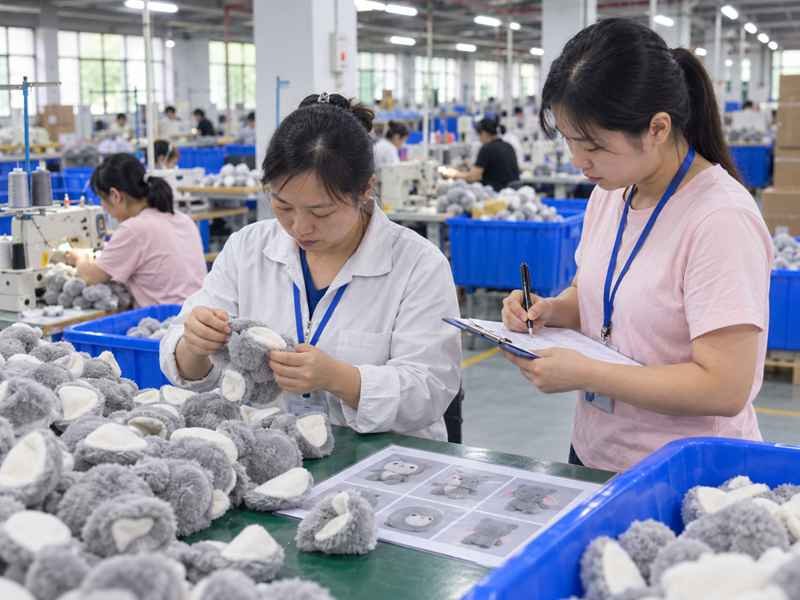
IPQC & Production Records
- Verify: SKU, revision, gate, finding, reaction.
- Value: proves quality is distributed through manufacturing, not saved for the end.

QC Lab & Physical Checks
- Verify: tool, purpose, product link, result.
- Value: connects equipment to a defined risk rather than a showroom display.
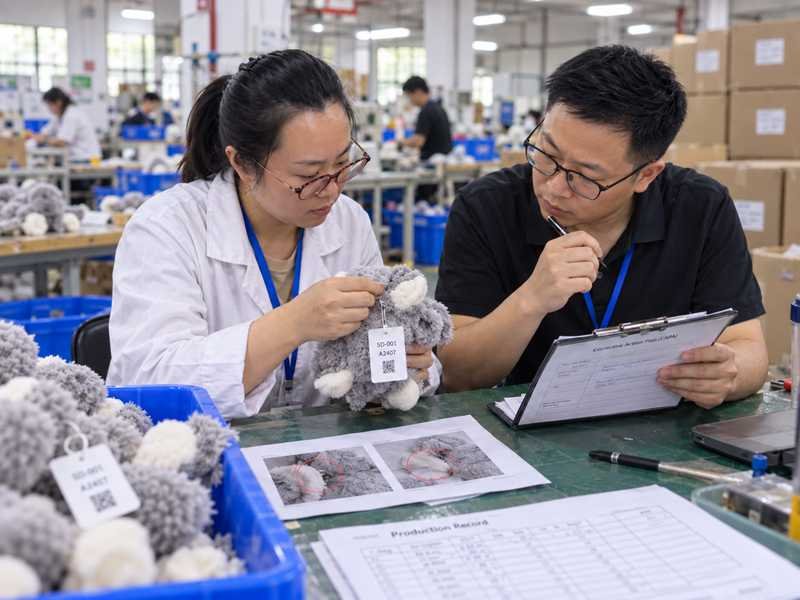
CAPA & Traceability
- Verify: evidence chain from issue to closure.
- Value: shows whether repeated problems become system improvements.

OQC & Shipment Release
Review packaging, barcode, carton, shipment identity, final release status, and how held or unreleased goods remain separated from approved shipments.
- Verify: SKU/PO, packaging revision, carton, release record.
- Value: confirms quality control remains active until the commercial shipment leaves the factory.
Quality Control Frequently Asked Questions
Ewin uses Project QC Plans, Golden/BOM references, IQC, IPQC, FQC, OQC, physical risk checks, needle control, defect records, CAPA, traceability, and controlled shipment release.
QC uses the current Golden/QC reference together with Frozen BOM, Released Pattern, final artwork, measurements, filling, component, label, packaging, and product-specific CTQ requirements.
The approved sample is converted into Golden Sample, Frozen BOM, released files, QC references, and change control so production and inspection follow one current product definition.
IQC controls incoming inputs, IPQC checks defect-source processes, FQC judges completed products, and OQC confirms packaging, SKU, carton, quantity, and shipment-release requirements.
Specified unit-level appearance, workmanship, identity, label, packaging, and project Critical items can receive 100% inspection. Destructive or laboratory tests follow representative-sample and Testing Plan requirements.
Sampling level and acceptance criteria are defined by project requirement, risk, production maturity, or appointed inspector rather than one fixed AQL value applied to every order.
Applicable ordinary plush routes use controlled needle handling, calibration, isolation, records, and at least three detection gates. Products containing designed metal require a product-specific foreign-material route.
The default reaction is Hold or Segregate, confirm affected scope, correct the issue, verify the result, and release only after the required quality condition is restored.
Traceability can link Product ID, material/component lots, production line or team, dates, QC records, packaging batch, inspector, and shipment information for backward and forward investigation.
Yes. Qualified brand QA teams or appointed third parties can arrange project-specific inspection or factory verification subject to scope, timing, confidentiality, and the current production status.
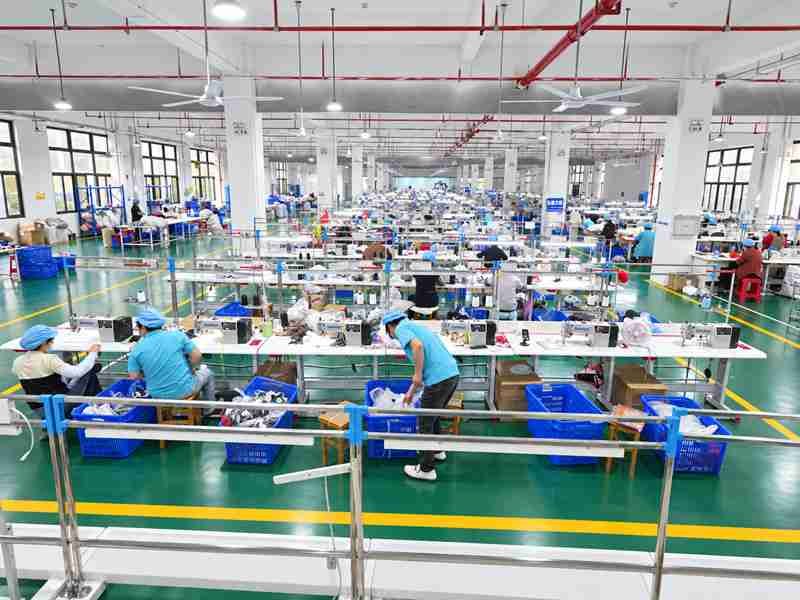

Send Your Project for a Quality Review
Share the information that defines what must be protected before Ewin builds the Project QC Plan. Include your company, role, product type, artwork or approved sample, current sample stage, SKU count, quantity, target market, critical character or functional features, known defect history, packaging, target launch date, and any existing inspection checklist or retailer requirement. If another supplier is involved, explain the quality problem you want to prevent – bulk mismatch, color variation, seams, filling, hardware, function, mixed SKU, barcode, packaging, or repeated CAPA failure. Upload the current Golden or sample photos, BOM, QC checklist, inspection report, defect photos, test report, packaging file, or third-party inspection requirement so Ewin can identify CTQs, likely quality gates, evidence needs, and the next review step.
Suggested information:
- Company
- Business Email
- Company Website
- Role / Department
- Customer Type
- Product Type
- Artwork / Approved Sample
- Current Sample Stage
- SKU Count
- Estimated Quantity
- Target Market
- Critical Quality Features
- Known Defect History
- Existing QC Checklist
- Required AQL / Inspection Plan?
- Third-Party Inspection Required?
- Packaging Type
- Target Launch Date
- Main Quality Concern